Showing posts with label Irom Sharmila. Show all posts

Tuesday, 18 October 2011

India march over 'draconian' anti-insurgent law: 10 states, 4500 km


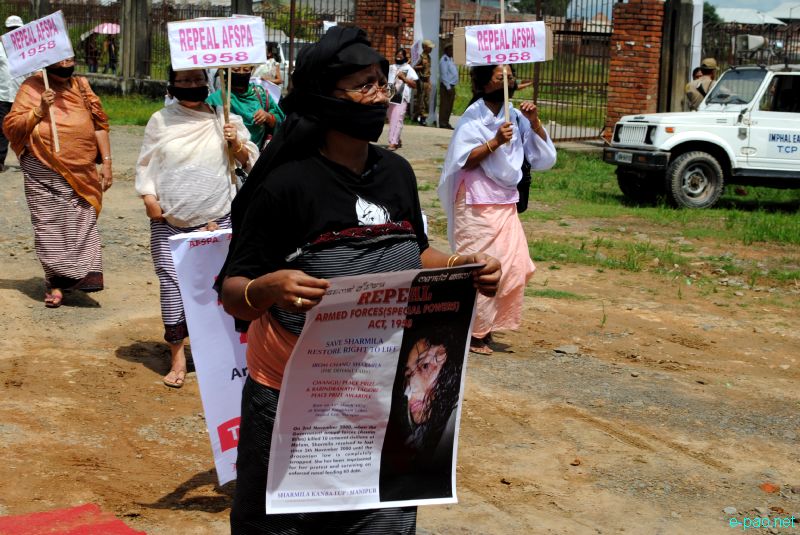
Save Sharmila Jan Karwan to travel 10 States, 4500 kms

The anti-Armed Forces Special Powers Act (AFSPA) Srinagar-Imphal yatra took off from capital Srinagar on Sunday afternoon with prominent social activists in the lead.

The yatra would conclude at the Jawaharlal Nehru hospital Imphal on October 27 - where activist Irom Sharmila is admitted - after traversing a distance of 4500 kms.

Irom Sharmila, a civil rights activist has been on a hunger strike since November 2, 2000, demanding the repeal of AFSPA.

Noted social activist, Medha Patkar, Dr Sandeep Pandey, Magsaysay awardee, prominent activist from north east Babloo, Faisal Khan, leader of the National Alliance of People's Movement, Irom Singhjhit, the brother of Irom Sharmila, Engineer Abdul Rashid, local independent MLA were among the 25 people from various states who joined theyatra.

The activists earlier visited the historic Hazratbal shrine to offer prayers 'for justice and peace'.

While addressing a rally at the Srinagar press enclave, Medha Patkar said that 'we will continue our fight till AFSPA is withdrawn'.

"We are against violence as it doesn't solve issues that can be only resolved through dialogue," she said.

In his speech, Faisal Khan said that 'the main objective of the yatra is to generate public opinion about the sufferings of the people affected by AFSPA'.

"We believe that there is no place for such laws in a democracy. We are against violence in any form. These laws are not only dangerous, but create a rift between the public and the administration," Khan said.

The activists shouted slogans, "down with AFSPA".

They later left Srinagar for Jammu on way to Imphal with the activists saying that 'more and more people will join us as we pass through major cities'.

"Our aim is to spread awareness about Irom Sharmila, who has been on a fast demanding the withdrawal of AFSPA," the activists said.

Monday, 10 October 2011

Irom Sharmila, a Gandhian made of a different metal


Irom Sharmila took the cudgels to challenge the might of the government and her method has always been Gandhian, shorn of violence, concrete in belief and consistent in perseverance. Irom Sharmila is a Gandhian made of a different metal.

THE ANTI corruption movements led by Yoga guru Baba Ramdev and anti-graft Gandhian activist Anna Hazare turned symbol of youth's aspirations in India, have done a world of good to a distinctly different pro-human rights struggle led by the lady with nerves of steel, Irom Sharmila. Irom has been on hunger strike for last 11 years but she has largely been unnoticed as she sought to repeal the Armed Forces Special Powers Act, 1958.

Finally, the hunger strikes by people's leaders has brought the strong willed human rights crusader in the national debate. The recent hunger strikes by Ramdev and Anna has put across a message to Irom that a team is required to make authorities listen. And, now Team Irom Sharmila is taking some concrete shape and it seems to be taking definite cue from Anna Hazare movement against corruption.


Team Irom Sharmila has now decided to intensify their movement in midst of ongoing blockade in Manipur for more than two months-- by Sadar Hill District Demanding Committee and a counter blockade by United Naga Council. The economic blockade of the national highways connecting Manipur with the rest of the Northeast has created an acute shortage of essential commodities in the state.

LPG is selling at Rs 2000 while petrol is selling at over Rs 160, potatoes at over Rs 50 a kg and tomatoes nearly Rs 80 a kg. Even the life saving medicines are hard to find. Team Sharmila wants to exploit the prevailing situation to bring forth their demand for repeal of AFSPA which has made life of ordinary citizens in the state equally vulnerable. Sharmila supporters claim that under the AFSPA rule, an average of two-three persons are being killed by the armed forces and no action is being taken against them.


The Armed Forces Special Powers Act was legislated in 1958 to fight the internal armed rebels. The AFSPA was aimed at meeting the challenges posed by the Naga insurgency in the erstwhile NEFA. It was later extended to entire northeast and in Jammu and Kashmir in 1990, after emergence of terrorism sponsored by Pakistan.

But, its imposition in peace time has met with resistance from the human rights activists but the government has maintained that the Act is necessary to keep the disturbing forces in check. The insurgents and separatists in both regions have used the government's decision to impose AFSPA as tool to alienate the resident population.

In Manipur, Sharmila took the cudgels to challenge the might of the government and her method has always been Gandhian, shorn of violence, concrete in belief and consistent in perseverance. And, truly the movement has now drawn inspiration from another Gandhian activist, Anna Hazare, who challenged the mightiest government of the largest democracy for going away from the popular perception on corruption and its handling.

Though in certain parts of the northeast, people have tried to give it an ethnic colour by saying that the AFSPA is aimed to making people with mongoloid features suffer at the hands of rest of the mainland ethnic groups. But, Sharmila has always detested such views while terming the Act draconian. This Gandhian (consciously or not) activist needs to be dealt with in a better manner by the state and the central governments. Putting her in police custody or force-feeding her is not a way to deal with peaceful protest that the father of the nation espoused. Irom Sharmila is a Gandhian made of a different metal.

Friday, 7 October 2011

Anti-AFSPA stir has got new motivation from Anna’s crusade against corruption


Supporters of Manipur’s ‘Iron Lady’ Irom Sharmila, who has been on hunger strike for the last 11 years demanding withdrawal of the Armed Forces Special Powers Act (AFSPA) from the state, are inspired by how Anna Hazare steered his anti-corruption campaign to success by fasting for only 12 days.
“It has been an inspiration for us. We have realised that if our movement is more organised and we manage to garner a pan-India support, the government would be bound to listen to us,”  said Sharmila’s long-time associate Babloo Loitongbam.
However, Loitongbam admitted that theirs is a much more difficult fight than Hazare’s.
Sharmila’s elder brother Irom Singhajit, who has now turned into a human rights activist, also admitted that their struggle against the ‘draconian’ AFSPA has got new motivation from Hazare’s crusade against corruption.
“His movement shows that Parliament also listens to the voice of people. So this is the right time to strengthen ourselves and make our voices heard,” he said.

Irom Sharmila supporters are hoping the media and the government will pay more attention to their cause, thanks to Anna's campaign. Reuters
Singhajit said they have realised is that there must be a political platform to voice concern about the AFSPA. However, he clarified, “That doesn’t mean we will support any particular political party.”
Babloo, who leads Manipur’s Human Rights Alert and the Just Peace Foundation, said they are looking to broaden their support base.
“We need to solicit support from all progressive forces and civil society groups all over the country. And then, we need to form a lobby within the government. Using all of them we have to communicate that removing the AFSPA will help the growth of India’s democracy,” the activist said.
Now, the biggest challenge before them is to run an aggressive and unrelenting anti-AFSPA campaign in the national capital just the way Hazare did, Babloo said.
“We are sitting here in Manipur, which is far from Delhi. That is why we are ignored. For us, having a sustained campaigning in Delhi is difficult but very important. We are trying to do that through our supporters there in Delhi,” he said.
While fasting in Delhi’s Ramlila Maidan for 12 days, Hazare had made the entire nation come to a standstill following which Parliament decided to consider a strong Lokpal bill.
Sharmila, on the other hand, is fighting a lone battle in an isolated ward of the Jawaharlal Nehru Hospital in Imphal city. She has been forcibly nose-fed for the last 11 years.
In Delhi, Sharmila’s supporters from various civil societies like the National Alliance of People’s Movements (NAPM), Asha Parivar, Chetna Kendra, etc. have joined hands and are campaigning with renewed vigour.
Her supporters are happy that after Hazare’s movement, suddenly the media, intellectuals and even the government has started discussing the issue afresh.
Even former Union home secretary G K Pillai had recently remarked that Sharmila’s efforts were not appreciated by the rest of India till Hazare sat on a fast.

Monday, 3 October 2011

After Anna Movement, Indian Youth Gears-up For 'Save Democracy, Repeal AFSPA'


Pune students to kick off signature campaign in colleges, hold seminars and candlelight marches to build support for Manipur Iron Lady's 11-year campaign for repeal of Armed Forces Special Powers Act. After their massive show of support for anti-corruption crusader Anna Hazare during his recent indefinite hunger strike for the Jan Lokpal bill, students in the city are gearing up for one more big campaign for another activist known for taking on the government using the Gandhian means of fasting.

The nationwide signature campaign started from October 2, which is Gandhi Jayanti, and will culminate in Delhi on December 10, Human Rights Day. "We will collect signatures and hand these over to President Pratibha Patil on December 10. We have also demanded the repeal of other draconian laws like the UAPA, MCOCA, and CSPSA," said Mukta Shrivastava, an activist. "We want to resist the increasing curtailment of democratic spaces."

Veteran Gandhian Anna Hazare is likely to travel to Manipur to personally urge rights activist Irom Sharmila to end her 10-year-old hunger strike.

Irom Sharmila, known as the Iron Lady of Manipur for being on a hunger strike for 11 years to press for the repeal of the Armed Forces Special Powers Act (AFSPA), has so impressed students here that they have set their minds on building a groundswell of support for her in the city. Towards this end, student groups from various colleges in the city along with activists of the National Alliance for People's Movement (NAPM) and other NGOs have decided to start a signature campaign. Starting from this week, volunteers will visit colleges to encourage youth across the city to participate in the movement 'Irom Sharmila Solidarity Campaign'. Their aim is to collect thousands of signatures and organise seminars and candlelight marches for the next couple of weeks to raise awareness on the AFSPA.

The activists say the government should immediately work out and announce a phased, time-bound demilitarisation plan to withdraw the army and other paramilitary forces from internal security duties in the Northeastern states and Jammu and Kashmir. They have also asked the National Human Rights Commission (NHRC) to visit Sharmila and Manipur to give take note of the human rights violation in the region and take appropriate action.

Irom Sharmila finds support in Ahmedabad
Ahmedabad: As visitors trouped in at Sabarmati Ashram on Sunday, October 2, a small table stationed at the entrance generated interest of many. "In solidarity with Sharmila", said a white banner behind the table encouraging a signature campaign in support of Irom Sharmila .

As Sharmila continues to struggle for peace and justice, her supporters in the city felt that Gandhi Ashram and October 2 (Gandhiji's birthday) was the ideal occasion to kickstart a signature campaign to hold up her cause. The endeavour was organised by Janpath who received more than 500 signatures in her support. The campaign will continue till October 10.Hyderabad Manipuri Society appeals for support to Sharmila

The Hyderabad Manipuri Society in association with the National Alliance of People’s Movement, Andhra Pradesh Chapter has launched a campaign on October 2, at the Ambedkar Statue, Tank Bund, Hyderabad as part of the nationwide “Save Sharmila Solidarity Campaign” involving many organizations and people’s movements that is being launched across India at same time and date.

Delhi: In a highly significant move, which was pregnant with implications, youths from Manipur and civil society representatives, individuals and students marched to Jantar Mantar here on Gandhi Jayanti day calling yet again for repeal of the controversial AFSPA.Taking Gandhi "father of the Nation" as an epitome of peace and non-violence, the "Save Democracy " Repeal AFSPA campaign group chose the day as a symbolic beginning of a Nation wide call for an end to AFSPA in Manipur and other parts of North East and India.

A "Save Sharmila " signature campaign started from October 2 till December 10, another symbolic day which is International Human Rights Day.The group also called for support to the struggle of Irom Sharmila.Supporting the call for repeal of AFSPA and the non-violent struggle of Sharmila, Arvind Gaur , coordinator of ASMITA a theatre group based in Delhi told The Sangai Express that his group through cultural performance were creating awareness on the issue of AFSPA in North India.

Thursday, 29 September 2011

Regime of Czarist Russia of 18th century and Indian government same !!!


Movements of Irom Sharmila's and Anna Hazare's

The recent movements undertaken by Ms. Irom Sarmila and Mr. Anna Hazare are of very important considering their aims and objectives. Anna Hazare's recent movement rocked both theHouses of the LokSabha and the RajyaSabha the highest law making bodies of India.

Sharmila's decade fasting demanding repeal of the Armed Forces (Special Power) Act, 1958 (AFSPA) from Manipur has no support from the State and Central Governments. Thus dumped the Fundamental Rights of the people of Manipur being kept in the cold storage of both the houses of Lok Sabha and Rajya Sabha

The citizens of India need to consider which one of the two movements has more significance in the interest of the entire population of India. The Act of 1958 was imposed in Manipur since1980;some reported cases of atrocities committed by the security forces personals behind the screen of the Act of 1958.

Few lists of atrocities committed by security forces under the AFSPA in Manipur are as follows :

1. Extra Judicial Execution: from 1980 to2006 numbered 68 persons including two women. …. and many more;

2. Torture: from 1980 to 2006 numbered 49 people. ….. and many more;

3. Enforced Disappearance: from 1980 to 1994 numbered 15 persons……and many more;

4. Massacre: from 1984 to 2000 numbered 110 persons…. and many more;

5. Rape: from 1974 to 2004 numbered 10 females (6 virgins + 4 married)…and many more.

IROM SHARMILA

On 2nd November 2000 when the Indian security forces committed extra judicial execution of ten innocent civilians at Malom, Ms. Irom Sharmila (28 years old aspiring poet) resolved to fast until the draconian law is completely scrapped. She was imprisoned for her protest and has been surviving on nasal feeding for more than a decade now.

However, with every passing moment, her determination for an AFSPA free state is moving ever stronger. Sharmila yearns for peace and she realizes that the real peace comes only through justice. As a result of excessive activities of the armed forces personals under the AFSPA in Manipur, Manipuri women decried the security forces for creating a land of widows.

The gross violation of human rights committed by security forces especially the violence against women invoke Manipuri women naked protest in front of the 4th Assam Rifles western gate of Kangla in the heart of Imphal city on 15th July 2004, challenging the security forces to rape the protestors. The occurrence was the second onein the history of the world; the first was American naked women demonstrated before the White House to stop sending their husbands and betrothed ones to Korea.

The above facts show clearly that Sharmila's movement against AFSPA is of international significance. The Capitalist monopolies rule the countries and barred the Fundamental Rights of human being throughout the world, including people of Manipur. In the capitalist monopoly rules state venting the ways and means openly and freely to flourish corruption in these countries, which result involvement in corrupt practices by the highest authorities in the fields of economy and politics as appeared in numbers of media. To mention few such corrupt practices in India like the Kargil Coffin Scam, Commonwealth Game, the present 2-G Scam etc. In order to find out a true picture of such corruption, the CBI grills the involved persons like the Central Minister Mr. Suresh Kalmadi in connection with the misappropriation of Funds of Commonwealth Games, Mr. A Raja, and Member of Parliament in connection with the 2-G Scam etc. are very glaring example. It is appeared in the media that the case of Mr.Suresh Kalmadi is likely to drop from the case due to his dementia.

Mr. Anna - please try to convince your good-self that the workers are the real producers of the needs of the entire humanity.They built civilization. Yet, when they demand high wages, better working conditions, health insurance etc. they are suppressed and jailed under fetters and kept without trials. If India ever had a place like Siberia they should have been exiled there that was done by the Czar of Russia. One last question is that: Is there any difference between the regime of Czarist Russia of 18th century and of present Indian government? In Hindi the common people address the rulers/officials as mai-bap, and why there is no close relationship between the two? Instead the mai-bap is heavily guarded by Z category security- what is wrong with the mai-bap? You need to think deeply.

Mr. Anna might have full conviction of "Satyameva Jayate" inscribed in the Ashok Chakra - the emblem of India. The inscription is only a philosophical phrase which has nothing to do with the poor masses of India. So the best and the lasting movement on your part in the interest of the unemployed, half-starve hungry millions- and proceed to serve them for their better future, chalk out your necessary programmes, Acts and actions, move forward without hesitation.

Mr. Anna, I prefer your valued action to the interest of the million of masses who are facing unemployment, hunger and chaos in their lives in lieu of supporting the interest of the wealthy few.

By: NNripen Singh,AssistantResearcher, CORE.

Anna To Meet Iron Lady of Manipur


Veteran Gandhian Anna Hazare is likely to go to Manipur to personally urge activist Irom Sharmila to end her 10 years long hunger strike.

Sharmila, has been fasting, since November 2000, demanding for the repeal of the Armed Forces (Special Power) Act, 1958 (AFSPA) in the North-East.

After the success of the Jan Lokpal movement, team Anna was flooded with request from activists from various parts of the country asking the team to lend its support to their individual causes.

As a follow up of the decision, Sharmila’s case has come in for discussion. Sources close to the anti-graft activist maintains that Hazare had expressed concern about the condition of Sharmila and wants an early end to her marathon fast. At present she is being force fed at the Jawaharlal Nehru Hospital close to her home in Imphal East.

During the Jan Lokpal movement, Sharmila had expressed support for the cause through letter.

In continuation of the Team Anna's earlier decision, two members of the team will be leaving for Imphal soon. Although the names are yet to be finalised. Insiders say that Manish Sisodiya and supreme court advocate Prashant Bhushan would be included in the team.

Sources close to Hazare said other than urging Sharmlla to end her hunger strike, the Gandhian is keen to visit the other North-Eastern parts too.

Sharmila's demand for repealing the AFSPA will also be studied in detail as Team Anna has expressed concern about the possible implications in other sensitive parts of the country.

Sources close to Hazare also view that other than urging Sharmila to end her hunger strike, the Gandhian is keen to visit the North-East for other reasons.

"There exists a mental block in various parts of the country, which has caused a divide between the North-East and the rest of the country. Given the iconic stature of Anna, his visit would go a long way in bridging the divide and to integrate those parts into the greater psyche of the nation," the source said.

Thursday, 22 September 2011

SHARMILA A SYMBOL OF PEACE AND AHIMSA


Who, in the land of Mahatma Gandhi, will not be moved at the disrespect and neglect of Manipur’s daughter and Iron Lady, Irom Sharmila, who has been struggling to uphold human rights in the states through the Father of the Nation’s path of Ahimsa and Satyagrah?

Only those who have no regard for democracy, non violence, harmony, tolerance and humanity he epitomized throughout the freedom struggle he led against the British rule in India.Manipur is now ill – famed for incessant fake encounters with insurgents and wanton killings of innocent citizens perpetrated by security forces in the name of self defence. A horrendous incident, for instance, was the killing of 9 innocent civilians by security men within the campus of the Regional Institute of Medical Sciences & Hospital, Imphal on the 6th of June, 1995 when security forces, being enraged by gunshots allegedly by militants,randomly shot at the patients’ parties after the real culprits had already fled the spot. There were vehement public outcries against the incidents from time to time but so frequent were such incidents that they gradually lost the sting to excite the common people.
Irom Sharmila, Manipur’s torch bearer of peace and human rights continues to languish in confinement and is still being misunderstood, misinterpreted and neglected.

However, November 2nd of 2000 marked a turning point with the emergence ofIrom Sharmila in Manipur’s history of struggle for human rights. On this day, some security men suffered casualties in an encounter with a handful of rebels at Malom. They lost their sense of being public protectors and were flung into a fury, shot whomever they saw and mercilessly killed ten innocent civilians in their wanton spree. Utterly shocked at the gruesomely atrocious crime, the young girl Sharmila resolutely embarked on her fast unto death campaign demanding the repeal of the Armed Forces Special Powers Act (AFSPA), 1958 and restoration of human rights in Manipur as guaranteed by the Indian Constitution. Her relentless, non – violent struggle for the cause of human rights and peace has now stretched into ten long years.
Sharmila has thus become the personification of courage, sacrifice and non – violence while struggling for the noble cause of humanity, undoubtedly with no parallel in human history. She has been honoured with the Gwanju Award of South Korea, Maliyamma Award (2009) of the Maliyamma Foundation of Kerala and the Rabindranath Tagore Peace Aard (2010) of the Indian Institute of Planning & Management. No wonder, even the Mahatma would have been thrilled with this decade – long feat of the Iron Lady. But, behold! The Government of her own native state of Manipur has been treating her as nothing less than a nuisance and putting this great soul of Manipur in confinement on the charge of attempting to commit suicide. Even worse, to the Government of India, Sharmila is simply a non – entity and her struggle a non issue.

Mahatma GandhiThe AFSPA obviously provides extraordinary power to the security personnel but none the less, it is not a supra – constitutional law which permits them to perpetrate random killings, rape women and violate the fundamental rights enshrined in our Constitution which ensures dignity of the individual. It is only through the abuse of this Act that the security men incessantly commit such crimes even in spite of the historic protest of Irom Sharmila.

The 17th Assam Rifles arrested the girl Th. Manorama on the night of the 10th of July 2004 from her house and charged her of being involved in insurgency activities but abandoned her after torture, rape and murder in open violation of human rights. Had she been tried and punished duly under the law, the armed forces would have been praised.

The AFSPA Act was invoked in Manipur in 1978 to contain secessationist movements. However, the efficacy of the use, or overuse, of this law has been thoroughly belied in the sense that, in spite of repressive measures through the abuse of the draconian law, there has been increasing growth and multiplicity of the insurgent outfits resulting in increasingly unwieldy conflict situation. It is thus evident that the effect of the AFSPA is rather highly toxic, let alone remedial for insurgency. Even the top brass of the Indian Army have, after their retirement, viewed that the revolt cannot be resolved with the use of arms.Despite this, the Government still continues to ignore such truthful findings and opinions and the security forces carry on with fake encounters, killing of innocent people and raping of women more than before.
The Gandhian values are now being replicated by Sharmila and have thus been openly devalued by both the Central and State Government

A young pregnant woman Rabina Devi and a youth Sanjit Singh who was buying medicine for his ailing father was killed on the 23rd of July 2009 by the Manipur Police in the heart of Imphal Bazar during a fake encounter. The incident was vividly reported on by Tehelka magazine with undoubtable photo evidence as subsequently confirmed by the CBI.

The AFSPA, or any other law for that matter, makes no sense when they are abused and unlawful acts are blatantly committed by law enforcing agencies. True to the great ideals of Mahatma Gandhi for a free India, the world’s greatest democracy as so called now, the AFSPA should be rolled back without further delay. This should befittingly happen without further delay under the proud leadership of India’s present conscience keeping President, Pratiba Devi Singh Patil and Prime Minister Dr. Manmohan Singh. Let Irom Sharmila get a new lease on life to uphold rights and Mahatma’s ideals.

With his matchless weapon of Ahimsa aand Satyagraha, Gandhi disarmed the masses and ultimately won the hearts of the British and won freedom. The Gandhian values are now being replicated by Sharmila and has thus been openly devalued by both the Central and State Government. It strikes this author very often that, India could have never got her independence from British rule in spite of a thousand Gandhis’ struggles if the British happened to be endowed with similar perception and morality of Independent India’s ruling elite. It is lamentable that the mainland India’s intelligentsia of today simply do not have the liberal thoughts their colonial counterparts had more than 60 years ago.

Irom Sharmila, Manipur’s torch bearer of peace and human rights continues to languish in confinement, still being misunderstood, misinterpreted and neglected. May God save her life and awaken India to her call without further delay, lest the chapter of her struggle for human rights becomes a blot in Indian history, condemned by the liberal world. An unfortunate happening to the life of Sharmila, a true follower of the Mahatma, who has been on a decade long fast only for the cause of human rights and peace shall certainly give birth to an India being despised and hated by the whole world. Both the State and Union Governments shall be demeaned with an ignoble name in Indian History.

Sunday, 18 September 2011

Armed Forces Special Power Act: Remembering 9/11


A peace rally  to observe the Assent of the then President of India to the controversial Armed Forces Special Powers' Act on September 11 in 1958 with organised by Just Peace Foundation in collaboration with Sharmila Kanba Lup on September 11 2011 .
A peace rally / sit-in-protest to observe the Assent of the then President of India to the controversial Armed Forces Special Powers' Act on September 11 in 1958 with organised by Just Peace Foundation in collaboration with Sharmila Kanba Lup on September 11 2011 .
'9/11 of 1958 must remind us of the fact that Armed Forces Special Power Act came as a product of a political "decision" by the executive and declared a war on the people by disguising the declaration as a juridical measure to maintain law and order.' reads the The Sangai Express article by A. Bimol Akoijam.

The disguise war on the people residing in specific geographical locations has been condemned and protested. Continuing the struggle to bring and preserve the democratic ethos and principles, concerned citizens of the country opposed the '53 year long imposition of the Act. in the Northeast of India' and 21 year in Kashmir (Press Release from JPF) .

Among others, at present, the struggle is symbolised by the 11 year old hunger strike of Irom Chanu Sharmila. However, the protest in particular and the movement at large has 'endured in obscurity' recorded New York Times.

One of the reasons for the obscurity of the movement has been due to the successful propagation by the state machinery by locating the Act. within the legal paradigm to control the deteriorating law and order of a disturbed area. The dichotomy between the AFSPA and the law and order has been reinforced by the right base argument of 'denial of right to life' put forward by the dissenters of the Act.

However, the exclusivist nature of the discourse, i.e., AFSPA and Law and order on one side and AFSPA and rights violation on the other, has hide the fundamental question that it challenges the universally accepted democratic ethos and principles of all man are born equal and free.

Shifting of the discourse from the democratic ethos and principles has enable Mr. Chidambaram, Home Minister of India, to observed 'As I said, there is no consensus yet and I am trying to build consensus. I have not succeeded so far.

There is a statement of the Prime Minister (Manmohan Singh) that we will replace the AFSPA with a more humane act. So we are trying'. The comment of the Union Home Minister summarise the last fifty years of political history of Northeast India.

At the same time may be it also encapsulates the political future of the region too.

Saturday, 17 September 2011

Hunger striker's declaration of love angers her supporters


The world's longest-serving hunger striker has sparked controversy among her supporters by talking openly of her love for her British boyfriend and declaring her intention to marry him once she has finished her unprecedented fast.Irom Sharmila, who has been force-fed since 2000 when she started protesting about the conditions in Manipur state in north-east India, told an Indian newspaper that though she was in love with the man, her supporters were opposed to the relationship.

"The man I love is waiting for me impatiently. He came here to meet me but my supporters refused that idea," she told the Calcutta Telegraph, from her bed in the security wing of the JN Hospital in Imphal. "He is of Goan origin but a British citizen. That is why they are against the relationship."

Ms Sharmila, 39, added: "They don't like to appreciate our relationship. They are also very possessive, very mean, very one-sided." Her supporters seized on the interview, claiming the newspaper had focused on the relationship rather than her struggle against the Armed Forces Special Powers Act (AFSPA), which campaigners say provides impunity to security forces in the north-east, where there is a history of insurgency. It organised a boycott of the newspaper and burned copies.

The relationship between Ms Sharmila and Desmond Coutinho, 48, a human rights activist, is an intriguing footnote to the story of a hunger-strike that has lasted for more than 10 years. When The Independent interviewed Ms Sharmila last year, she coyly referred to her boyfriend and pointed to a carving he had sent her.

It transpired the couple had corresponded by letter and have met only once, earlier this year, when he attended one of the hearings she regularly attends with a magistrate. In an email, Mr Coutinho confirmed the "long romantic story". He added: "We will marry when she is freed. She now wears my [flowers] on a chain [of] gold."

Babloo Loitongbam, a human rights campaigner from Manipur, said Ms Sharmila's supporters were not opposed to her having a relationship, but believed that her family and associates should also be given access to her.

"It's very clear she has the right to have a relationship. She has the right to choose a spouse. But she also has the right to be in touch with activists and her family," he said.

The cause of Ms Sharmila, who is force-fed by a tube twice a day, has received some additional publicity following the recent fast by anti-corruption campaigner Anna Hazare. Earlier this summer, the Indian government buckled to Mr Hazare's campaign for the establishment of an anti-corruption ombudsman after he went without food for 12 days.

Mr Hazare and his senior team are now planning a tour around various parts of India. Mr Loitongbam said he had spoken with members of Mr Hazare's group and said two of them intended to travel to Manipur.

Ms Sharmila began her campaign following the shooting by paramilitaries of 10 people standing at a bus stop. No one has ever been held accountable. Campaigners say that every year, scores and even hundreds of people are killed by the security forces in the state.

Nil by mouth: Surviving without food

* A person can survive for up to 60 days without food, but they can last only 10 days without both food and water.

* In the first three days, the body lives off its stores of glucose. After that, the liver begins ketosis (breaking down the body's fat stores) and the person will begin to appear to waste away. Each individual reacts differently under this physical stress, but after about three weeks they will usually enter the starvation phase – when their body begins withdrawing fat reserves from vital organs. At this stage, death is imminent.

* Irom Sharmila's hunger strike is treated as a crime. She is force-fed a liquid mixture of carbohydrates and proteins through a tube twice a day. This has kept her alive for 11 years despite no food or water passing her mouth, but she is thin, pale, weak, her menstrual cycle stopped and her muscles have wasted away, partly because she is not permitted to exercise outside.

The time has come for Irom Sharmila to move on


Simrit Kahlon 


After dedicating a decade plus of her life for her people, Irom Sharmila has, recently, struck a personal and emotional cord by making public her love for one Desmond Coutinho, a 48-year-old writer and activist whom she met in March this year after a yearlong exchange of handwritten letters. One would like to wish her the very best, but for the knowledge that tragedy is lurking in the corners of her eventful existence yet again. She has treaded on this path in the hope that, as a sequel to the Anna wave, her demand for repeal of the Armed Forces Special Powers Act (AFSPA) in her home State, Manipur, will also be met and then she will be free to lead a normal life. This may not happen in the near future due to a number of reasons. 

During the ten years since Irom Sharmila took an emotionally charged decision to go on a fast, the environment in her home State has changed beyond recognition. Manipur today is riddled with the ills of looting, kidnapping and extortion carried out by a number of insurgent groups. Most people who can afford to move out from the State and relocate elsewhere are doing so. Those still residing in the State are paying heavy amounts as protection money to the insurgent groups. The insurgent groups, in turn, are using the money collected to purchase large tracts of land in West Bengal, Sikkim and the rest of India. On the pretext of the prevailing disturbed situation, the State government is receiving large sums as dole from the Central Government which, probably, lines the pockets of the politicians. Some politicians are even believed to have a nexus with the insurgents and they loot in tandem. The lot of the common man has deteriorated from bad to worse. The changed scenario in the State means that the cause espoused by Irom Sharmila has lost much of its relevance. 

Let us now compare her cause with the "Anna" movement. What were the factors that led to the resounding success of the latter? Anna had a past for which the people knew him; he had well known people to project him and his cause to the masses and the media. The issue touched all rungs of society and the people identified with it. Overall Anna was a catalyst who fired up the masses. Most importantly, he recognised the time that was opportune to call off his agitation. He bowed to the dictates of reality and logistics and, at the same time, drove home his point well enough to find a place for himself in history. Herein lies the difference between Anna Hazare and Irom Sharmila. She has not been able to appreciate the right time to pull out. 

One can imagine a host of alternate life scenarios for this dynamic lady. She could have chosen to serve her people by helping them distinguish the right from wrong and thus helped in creating an environment conducive for the repeal of AFSPA. Instead, she has thrust herself into a typical Catch-22 type of a situation, where neither can she move forward nor will her supporters allow her to step back. She has become a prisoner of her own cause. No doubt she has been nationally feted and internationally acknowledged, yet she remains nothing more than a poster girl. So much so that today when she has found the man whom she loves and would like to marry, her supporters have denied to him even access to her and in the process left her very embittered. So why is she bent upon being a martyr without a cause? As it is, she has wasted the most productive period of her life. 

Today, Irom Sharmila is nothing more than a golden goose for the small group of people who surround her and control her actions. Should she choose to eschew her unavailing struggle and live her life with a more positive perspective, it is her supporters who would stand to lose all the aid and sympathy that they garner in her name. 

In the final analysis it is the achievement that is counted, not the intention with which one works nor the sacrifices that one makes. Irom Sharmila is not being able to achieve because her cause is no longer relevant even to her State or her people much less the nation as a whole. Today, in Manipur, it is the much vilified Assam Rifles which is making the most sustained effort at maintaining peace and rehabilitating misled youth through counselling and vocational training. Those whom she is trying to dislodge have become the saviours of the people. Assam Rifles provides peace, security, economic boost, employment and whatever little development that is happening in the State. Why on earth will the people go against this organisation? The only thing that remains unchanged is her continuing fast. But one wonders after all, to what avail?
The central and the State governments, the media and more importantly the people of Manipur and the entire Nation have to get together and find ways and means to persuade Irom Sharmila to shed her misery. She has to be convinced that her issue is understood and respected and all efforts are being made to bring about an environment where her demands can be met. In the meantime, she would do herself and her people a great service by shedding the present self defeating path to lead a normal life, get married to the man she loves, have children and simultaneously work in areas that are beneficial for her people. It is time for her to move on.
(courtesy: The North Lines, J & K)